
Where bold ideas converge to solve society’s greatest challenges.

As proud leaders and active contributors to university-wide initiatives, Cornell Bowers is tackling society’s most urgent and complex challenges through interdisciplinary collaboration. By connecting fields such as artificial intelligence, climate science, assistive technology, design, health, and policy, we are driving boundary-breaking innovation and developing solutions with real-world impact.

Where we focus:


Sustainability + Agriculture

Leveraging cutting-edge technology, digital agriculture, and climate-smart solutions to drive innovation for a resilient and sustainable planet.
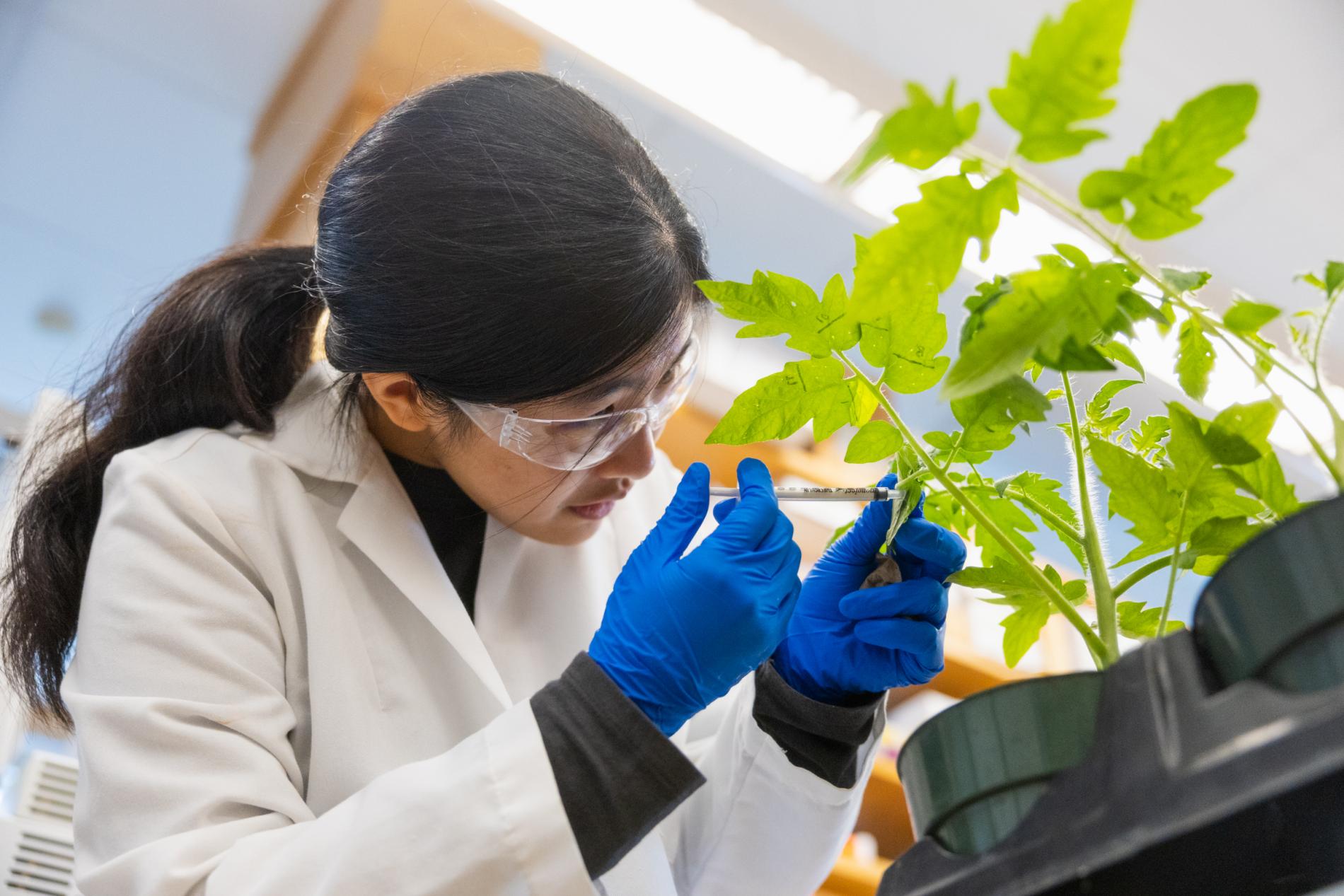
Woman with dark hair and ponytail using syringe on plant

Cornell is part of the nation-wide AI-LEAF Institute led by the University of Minnesota that aims at creating AI-powered knowledge and solutions to help empower farmers, foresters, and other agricultural stakeholders to mitigate and adapt to climate change.

Learn More

An NSF Expeditions in Computing research network led by Cornell with 13 U.S. academic institutions, exploring computational sustainability across conservation, poverty mitigation, and renewable energy through optimization, machine learning, and citizen science

Learn more

Part of the Cornell University AI for Science Institute, CAISI harnesses AI to tackle global sustainability challenges — from sustainable materials discovery to global energy and environmental systems, with a focus on decarbonizing energy and agri-food systems.

Learn more

Cornell's decade-long climate initiative, adapting breakthrough science into real-world solutions during our most critical decade. Fueled by collaboration across faculty, the 2030 Project removes silos and activates research across disciplines to find climate solutions now.

Learn More

The Cornell Agricultural Systems Testbed and Demonstration Site (CAST) for the Farm of the Future advances data-driven solutions for smart agriculture. Funded by a $2 million NSF planning grant for AI4Ag — it serves as a national testbed for AI in agriculture. Researchers, students, and industry partners can safely test AI innovations under real-world farming conditions.

Learn more

CIDA cultivates a community of researchers, farmers, industry partners, and stakeholders working to advance more sustainable agriculture and food systems, with a cross-disciplinary approach that spans life sciences, engineering, computing, and the social sciences.

Learn More

Founded through one of the first NSF Expeditions awards in 2008, ICS was created to perform and foster research in computational sustainability — and to establish a vibrant research community that helped launch the field itself.

Learn More


Ethics, Law + Policy

Examining the societal impacts of emerging technologies, developing frameworks for responsible innovation, and shaping policies that ensure equity and accountability.
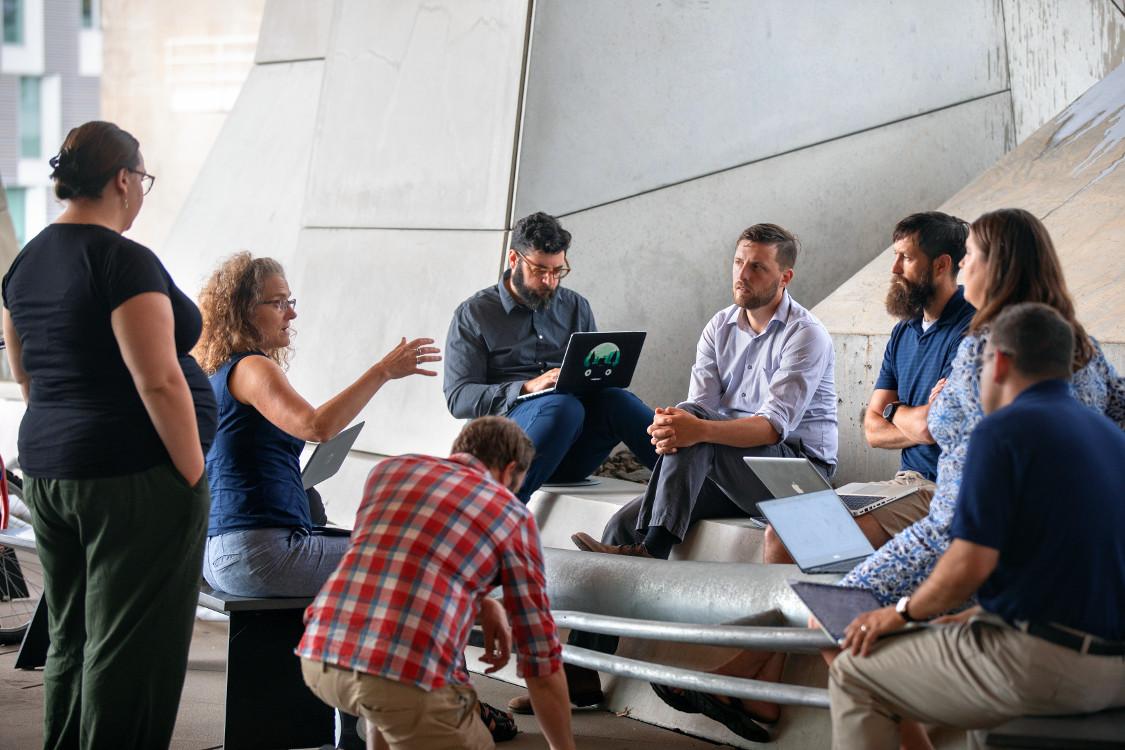
 
woman in blue shirts talks with a group of people seated around her

Housed within Bowers, FAccT approaches AI as a fundamentally socio-technical phenomenon, combining computational, legal, mathematical, philosophical, and sociological methods. The initiative engages researchers, policymakers, and practitioners with both normative depth and technical precision.

Learn More

A Cornell research initiative building simulation-based assessments, evidence traces, and human review methods for AI-ready skills. It creates AI-scaled, case-based simulations that reveal how people use AI, adapt to feedback, and collaborate under realistic workplace constraints.

Learn More

As artificial intelligence takes on coding, software management, and decision-making with minimal oversight, Cornell researchers launched an initiative uniting experts in AI, security, and verification to address the risks of autonomous systems that plan, reason, and act. This effort brings together leading researchers from the Cornell Ann S. Bowers College of Computing and Information Science and Cornell Tech to develop safety protocols for AI agents.

Learn More

Cornell Law's hub for researchers working at the intersection of law and artificial intelligence. The Center examines how AI is reshaping legal practice and education, how law and policy can govern AI, and how AI tools can advance legal scholarship.

Learn More

Embedded within Cornell Tech and launched in 2017, DLI analyzes the societal tensions arising from emergent digital technologies. Inspired by justice, democracy, privacy, responsibility, security, and freedom, it supports research on ethics, policy, and quality of life in socio-technical systems.

Learn More

AI systems today often reflect WEIRD (Western, Educated, Industrialized, Rich, Democratic) populations — less than 15% of the world. The Cornell Global AI Initiative addresses that gap by integrating global perspectives into AI research and practice.

Learn More

A Laude Institute moonshot project led by Cornell faculty proposing a three-part AI infrastructure for trustworthy civic discourse: AI assistants that help individuals articulate their views, AI moderators that surface common ground, and an independent AI auditor layer drawing on cryptographic verification.

Learn More


Interplay of Tech + Humanity

Advancing technical breakthroughs while deepening our understanding of their impact on people and society.

 

A strategic Weill Cornell Radiology investment at the intersection of AI, medical imaging, and clinical care. AI4MI develops, deploys, and disseminates cutting-edge AI algorithms and methods across a range of medical imaging problems.

Learn More

AIPrN trains students to combine precision nutrition with advanced data science, equipping them to tackle nutrition disparities and diet-related chronic diseases. It brings together Cornell faculty in nutrition, medicine, biomedical sciences, computing, and engineering.

Learn More

A Cornell research initiative building simulation-based assessments, evidence traces, and human review methods for AI-ready skills. It creates AI-scaled, case-based simulations that reveal how people use AI, adapt to feedback, and collaborate under realistic workplace constraints.

Learn More

Researchers from Cornell Tech and Cornell Bowers along with physicians from Weill Cornell Medicine and Columbia University VP&S, will use AI and machine learning to examine data from NewYork-Presbyterian in an effort to detect patterns that will help physicians predict who will develop heart failure, inform care decisions and tailor treatments for their patients.

Learn More

A Cornell Tech-based initiative in NYC connecting research, design, and deployment to build tools for people with disabilities and older adults. Focus areas span assistive robotics, AI for accessibility, inclusive sensing, and community partnerships.

Learn More

A university-wide effort to advance Cornell's leadership in AI research and education, while applying and evaluating AI across classrooms, laboratories, clinics, and university operations. It aims to advance responsible uses of AI in service of Cornell's public engagement mission.

Learn More

AI systems today often reflect WEIRD (Western, Educated, Industrialized, Rich, Democratic) populations — less than 15% of the world. The Cornell Global AI Initiative addresses that gap by integrating global perspectives into AI research and practice.

Learn More

DALI fosters research and community engagement to help people critically engage with digital and AI technologies. It focuses especially on the technology literacy challenges facing youth and vulnerable communities.

Learn More

Embedded within Cornell Tech and launched in 2017, DLI analyzes the societal tensions arising from emergent digital technologies. Inspired by justice, democracy, privacy, responsibility, security, and freedom, it supports research on ethics, policy, and quality of life in socio-technical systems.

Learn More

The Observatory improves teaching and learning at scale by learning from tutors — recording one-on-one and small-group interactions across many providers. The group is creating the world's largest data repository of tutoring interactions and the incredibly important work of teachers.

Learn More


New Frontiers of Science

Pushing the boundaries of science while advancing AI innovation in a rapidly evolving technological landscape.

 
a women with short black hair holds up a hand in front of a computer screen

Led by Cornell, NSF AI-MI accelerates the discovery of next-generation materials essential for energy, sustainability, and quantum technologies. The interdisciplinary team unites computer scientists, materials researchers, and data scientists at the interface of AI and materials research.

Learn More

As artificial intelligence takes on coding, software management, and decision-making with minimal oversight, Cornell researchers launched an initiative uniting experts in AI, security, and verification to address the risks of autonomous systems that plan, reason, and act. This effort brings together leading researchers from the Cornell Ann S. Bowers College of Computing and Information Science and Cornell Tech to develop safety protocols for AI agents.

Learn More

Part of Cornell's radical collaborations, CDSES unifies data science programs around questions grounded in human-generated data — computational social science, the economics/CS interface, digital agriculture, and urban platforms — with attention to privacy, security, and fairness.

Learn More

A university-wide effort to advance Cornell's leadership in AI research and education, while applying and evaluating AI across classrooms, laboratories, clinics, and university operations. It aims to advance responsible uses of AI in service of Cornell's public engagement mission.

Learn More

The Cornell University AI for Science Institute (CUAISci) advances AI-driven scientific discovery and sustainability research across fields including materials science, physics, biology, energy, food, and climate systems, while supporting interdisciplinary collaboration and postdoctoral training.

Learn More