Cornell Bowers
  • About
    About
    • Our History
    • Leadership
    • Academic Departments
    • Program Directory
    • Belonging at Bowers
    • Awards
    • College Offices
    • Events
    • Bowers’ Spaces
    • Engage + Support
  • Research
    Research
    • Undergraduate Research
    • Computer Science Research
    • Research Office
    • Information Science Research
    • Research News
    • Statistics + Data Science Research
  • Student Experience
    Student Experience
    • Undergraduate
      • Majors + Minors
      • Current Major Resources
      • Undergraduate Student Organizations
      • Student Services
    • Graduate
      • Degrees
      • Academic Planning
      • Graduate Student Groups
      • Support Services
  • News + Stories
  • Directory
    • Computer Science
    • Information Science
    • Statistics + Data Science
    • Computational Biology
    • Design Tech
    • How They Connect
    • Purposeful + Responsible AI
    • Tech that Drives Positive Change
    • The Interplay of Humanity + Tech
    • Unlocking Insights with Data

Our Departments

  • Computer Science
  • Information Science
  • Statistics + Data Science
  • Computational Biology
  • Design Tech
How They Connect
  • Purposeful + Responsible AI
  • Tech that Drives Positive Change
  • The Interplay of Humanity + Tech
  • Unlocking Insights with Data
  • Computer Science
  • Information Science
  • Statistics + Data Science
  • Computational Biology
  • Design Tech
How They Connect
  • Purposeful + Responsible AI
  • Tech that Drives Positive Change
  • The Interplay of Humanity + Tech
  • Unlocking Insights with Data
Back to people directory

Fred B. Schneider

Samuel B. Eckert Professor of Computer Science
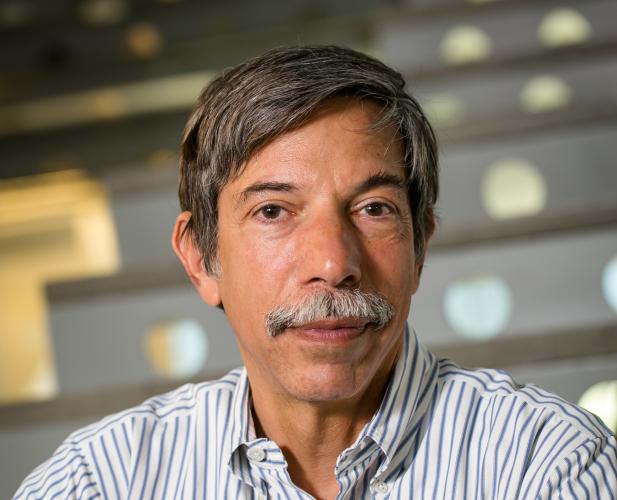
A photo of Fred Schneider, a man with dark gray hair and a mustache, in a striped shirt in front of a staircase

About

Fred B. Schneider is the Samuel B. Eckert Professor of Computer Science at Cornell University. He joined Cornell's faculty in Fall 1978 and served as department chair from 2014-2018. His Ph.D. (1978) is from Stony Brook University, having completed a B.S. in engineering at Cornell in 1975.

Schneider's research has focused on various aspects of trustworthy systems – systems that will perform as expected, despite failures and attacks. His early work concerned formal methods to aid in the design and implementation of concurrent and distributed systems that satisfy their specifications. He is author of two texts on that subject: "On Concurrent Programming" and (co-authored with D. Gries) "A Logical Approach to Discrete Mathematics." He and Bowen Alpern devised the now standard formal definition of "liveness properties" and provided the proof that safety and liveness are a fundamental basis for all trace-properties; that work received the 2018 Edsger W. Dijkstra Prize in Distributed Computing. He, with Michael Clarkson, also introduced the idea of a hyperproperty. But Schneider is also known for his research in theory and algorithms for building fault-tolerant distributed systems. His paper on the "state machine approach" for managing replication received (in 2007) an SOSP "Hall of Fame" award for seminal research. And his paper on fail-stop processors (with Richard Schlichting) received the Jean-Claude Laprie Award in Dependable Computing. More recently, his interests have turned to system security. His work characterizing what policies can be enforced with various classes of defenses is widely cited, and it is seen as advancing the nascent science base for security. He is also engaged in research concerning legal and economic measures for improving system trustworthiness.

Schneider was elected Fellow of the American Association for the Advancement of Science (1992), the Association of Computing Machinery (1995), and the Institute of Electrical and Electronics Engineers (2008). He was named Professor-at-Large at the University of Tromsø (Norway) in 1996 and was awarded a Doctor of Science honoris causa by the University of Newcastle-upon-Tyne in 2003 for his work in computer dependability and security. He received the 2012 IEEE Emanuel R. Piore Award for "contributions to trustworthy computing through novel approaches to security, fault-tolerance, and formal methods for concurrent and distributed systems." The U.S. National Academy of Engineering elected Schneider to membership in 2011, the Norges Tekniske Vitenskapsakademi (Norwegian Academy of Technological Sciences) named him a foreign member in 2010, and the American Academy of Arts & Sciences elected him to membership in 2017.

Schneider chaired the National Academies Computer Science and Telecommunications Board (CSTB) study on information systems trustworthiness that produced the 1999 volume Trust in Cyberspace. He is founding chair of its Forum on Cyber Resilience. He has served on the National Academies Naval Studies Board as well as the Pentagon's Defense Science Board and the Army Science Board.

In 2007, Schneider was elected to the board of directors of the Computing Research Association (CRA) and served through 2016. During that period, he was a member of CRA's Computing Community Consortium steering committee 2007-2013 and chaired the CRA Government Affairs committee. In Fall 2011, he started the CCC/CRA Leadership in Science Policy Institute; that event still runs biannually and he remains co-director.

Schneider is a frequent consultant to industry, believing this to be an effective method to effect technology transfer and a good way to learn about the real problems. In addition, Schneider has testified about cybersecurity research at hearings of the U.S. House of Representatives Armed Services Committee (subcommittee on Terrorism, Unconventional Threats, and Capabilities), as well as the Committee on Science and Technology (subcommittee on Technology and Innovation and subcommittee on Research and Science Education).
 

Research Website
Schneider's Website
Research areas
Ethics, Law and Policy
Tech and the law
Programming Languages
Security
Software Engineering
Systems + Networking
CV
View CV
Contact
(607) 255-9221
fbs@cs.cornell.edu
Location
Ithaca
Office
Gates Hall 422
Profile Type
Faculty (Department)
Computer Science
Faculty (Field)
Information Science

Awards

View all Awards Received

National Academy of Engineering Member

National Academy of Engineering
Fred B. Schneider
  • Service
  • 2011

About This Award

View Fred B. Schneider

IEEE Fellow

Institute of Electrical and Electronics Engineers
Fred B. Schneider
  • Research
  • 2008

About This Award

View Fred B. Schneider

IEEE Emanuel R. Piore Award

Institute of Electrical and Electronics Engineers
Fred B. Schneider
  • Research
  • 2012

About This Award

View Fred B. Schneider

Computing Research Association Distinguished Service Award

Computing Research Association
Fred B. Schneider
  • Service
  • 2016

About This Award

View Fred B. Schneider

American Academy of Arts and Sciences Member

American Academy of Arts and Sciences
Fred B. Schneider
  • Prominent
  • 2017

About This Award

View Fred B. Schneider

ACM Fellow

Association for Computing Machinery
Fred B. Schneider
  • Research
  • 1995

About This Award

An ACM Fellow is a member of the Association for Computing Machinery (ACM) who has achieved outstanding accomplishments in the fields of computing and information technology.
View Fred B. Schneider

AAAS Fellow

American Association for the Advancement of Science
Fred B. Schneider
  • Research
  • 1992

About This Award

View Fred B. Schneider
View all Awards Received
Cornell Bowers Cornell University
Information For
  • Current Students
  • Current Faculty
  • Current Staff
  • Alumni
  • Prospective Students
  • Industry Partners
  • Press + Media
Departments
  • Computer Science
  • Information Science
  • Statistics + Data Science
  • Computational Biology
  • Design Tech
Featured
  • Bowers Leadership
  • Commencement Weekend
  • Giving
  • Careers at Bowers
  • Facebook
  • Instagram
  • LinkedIn
  • X
  • Youtube Channel
Acknowledgement of Gayogo̱hó:nǫɁ Land
Cornell Tech

Footer - Policies

  • Web Accessibility
  • Privacy Policy
  • Equal Education & Employment

© 2026 Cornell Ann S. Bowers College of Computing and Information Science, Cornell University