
ML Made Live: How We Make Good Models Useful at Scale
Time: 11:45 a.m.
Date: December 4, 2026
Location: Gates Hall/G01
Dean's Distinguished Lecturer: Tushar Deepak Chandra, Ph.D. '93, Distinguished Engineer, Google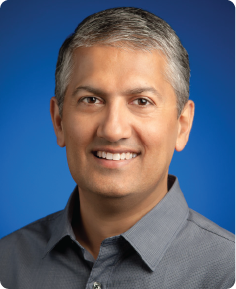
Abstract: Training a strong machine learning model is only the starting point; making it useful to billions of people at low latency and reasonable cost is a very different engineering problem. At scale, even a 0.01% improvement justifies system complexity - provided you can measure it.
In this talk, I will focus on what happens after a model is trained. After a brief primer on how modern models run on accelerators and across a shared fleet, I’ll examine why measuring both model quality and fleet efficiency is surprisingly subtle. I’ll then contrast broad systems wins with deep algorithmic wins, walk through some practical techniques across serving, quantization, scheduling, recommenders, and diffusion distillation, and look at the emerging role of AI in optimizing systems and automating engineering workflows - closing with open research problems.
Bio: Tushar Deepak Chandra is a Distinguished Engineer at Google working on AI transformation: rethinking how major engineering and business operations work with frontier models. Previously, he led Google’s Applied ML organization, taking research in distillation, LoRA, small language models, agents, and foundation recommenders into products. At Waymo, he led onboard software through a major revamp and its first nine releases, scaling to 24x7 driverless commercial rides in San Francisco and Phoenix. Earlier, he co-founded Google’s Sibyl ML platform, was on the core Bigtable team, created Google’s Paxos implementation, and built distributed systems at IBM Research. He holds a B.Tech. from IIT Kanpur and a Ph.D. in Computer Science from Cornell University (advised by Sam Toueg), where his work on unreliable failure detectors, with Sam and Vassos Hadzilacos won the Dijkstra Prize.