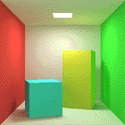
The benchmark for physically based rendering.
The Cornell Program of Computer Graphics has become best known for its research on physically based rendering. We believe that computer graphics simulations will never become predictive of reality unless we correctly model the physics of light reflection and light energy propagation within physical environments.
The Cornell Box experiments have come to symbolize our approach to physically based rendering. The Cornell Box is a simple physical environment for which we have measured the lighting, geometry, and material reflectance properties. Synthetic images of this environment are then created, and compared to images captured with a calibrated CCD camera. In this way, we can confirm the accuracy of our simulations.
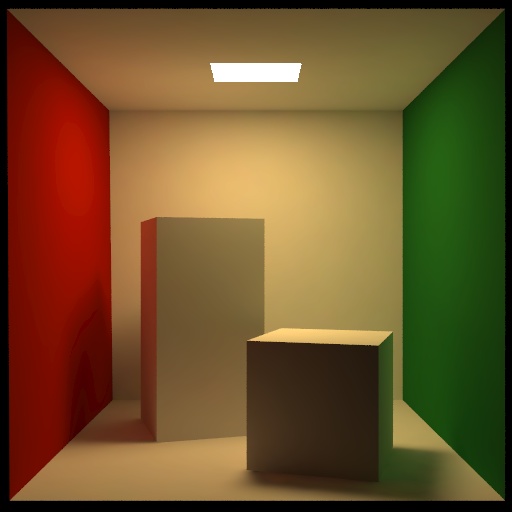
History of the Cornell Box
In 1984, Cindy Goral, M.S. Arch. ’85, published a landmark paper, and the first on the novel technique of radiosity: “Modeling the interaction of light between diffuse surfaces.” The paper’s coauthors included professors Kenneth Torrance, Donald Greenberg, and Bennett Battaile. "The Cornell Box" made history as the first radiosity image, with computations measured in tens of minutes.
The box has been used for many experiments over the years, and has changed to adapt to the needs of our researchers.
This is the original Cornell box, as simulated by Cindy M. Goral, Kenneth E. Torrance, and Donald P. Greenberg for the 1984 paper Modeling the interaction of Light Between Diffuse Surfaces, Computer Graphics (SIGGRAPH '84 Proceedings), Vol. 18, No. 3, July 1984, pp. 213-222. Because form factors were computed analytically, no occluding objects were included inside the box.

This simulation of the Cornell box was done by Michael F. Cohen and Donald P. Greenberg for the 1985 paper The Hemi-Cube, A Radiosity Solution for Complex Environments, Vol. 19, No. 3, July 1985, pp. 31-40. The hemi-cube allowed form factors to be calculated using scan conversion algorithms (which were available in hardware), and made it possible to calculate shadows from occluding objects.
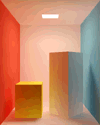
This image was computed by Francois Sillion, et al. as part of a research into using spherical harmonics to represent Bi-directional Reflectance Distribution Functions (BRDF) for surfaces. While the previously blue right wall helped demonstrate the familiar color bleeding effects of radiosity solutions, the reflectance properties of a green wall yield more balanced solutions.
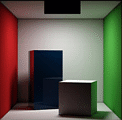
This simulation was computed using discontinuity meshing software developed by Dani Lischinski, Filippo Tampieri, and Donald P. Greenberg.