
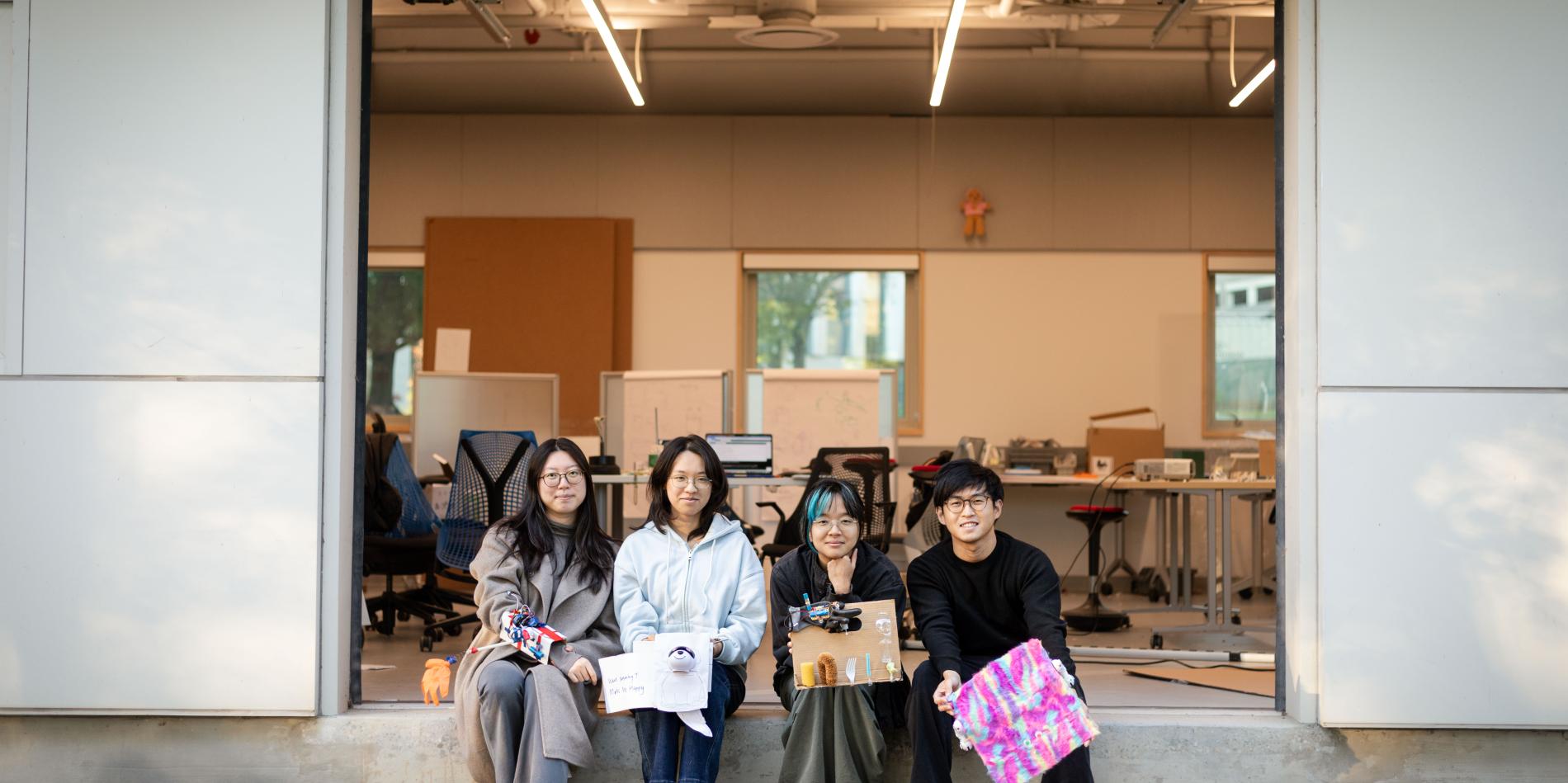
Eddie Zhu imagined a doormat that would insist on being used.
A second-year doctoral student in the field of information science, Zhu designed the mat to chase someone who entered without wiping their feet, demanding attention through a repurposed toy dog’s voice responses. Contact with a shoe could trigger a more appreciative reply.
Zhu is one of four graduate students from the Cornell Ann S. Bowers College of Computing and Information Science who are taking “Re-Designing Robots” (INFO 6420), a graduate studio design course taught by Malte Jung, associate professor of information science and the Philip M. ’62 Young Sesquicentennial Faculty Fellow in Cornell Bowers. In the course, for a first assignment, students had one week to take apart robot toy dogs and reimagine new machines with their components.. However, the assignment came with a condition: the students’ robots had to be “useless.” Final projects included bots that greeted people at a party, dispensed seasoning, scrubbed dishes, and ensured visitors wiped their shoes.
The project brief cast students as designers at a fictional toy company, Chindogu Automation, named for "chindogu," the Japanese concept of creating devices that appeared to solve everyday problems but might cause more problems than they solved. It also referenced inventor Simone Giertz’s deliberately impractical robots.
Their prototypes explored familiar frustrations and small decisions. Building them required working through unreliable sensors, unsuitable materials, and movements that did not quite do what their designers intended.
The project, a warm-up for the course, asked students to explore those difficulties through sketching, physical prototyping and testing. An invention could be impractical and still offer something to learn about how people interact with robots.
“Asking for something ‘useless’ gives students room to experiment and take risks,” Jung said. “Our focus is on the design process, and failures are encouraged.”

Asking for something ‘useless’ gives students room to experiment and take risks. Our focus is on the design process, and failures are encouraged.
Associate professor of information science and the Philip M. ’62 Young Sesquicentennial Faculty Fellow
Giving robots a personality
Di Wen, a first-year doctoral student in the field of information science, imagined a problem that could arise at a party. A self-described introvert, Wen wanted a way to greet several people without making anyone wait.
“You meet three new friends, but you only have two hands,” Wen said.
An extra hand could help.
Wen built a wearable handshaking robot operated with the toy’s remote control, adapting the dog’s existing movements into a social gesture. The idea extended Wen’s interest in robotics beyond making objects to exploring how a robot could help people interact with one another.
Wen’s research uses robotic arms for three-dimensional knitting and weaving, with the goal of helping makers rapidly prototype a wider range of shapes. She came to the course wanting to broaden her thinking beyond what hardware can do; she hoped to better understand “building the communication or connection between human and technology,” Wen said.
Zhu’s starting point was his concern for cleanliness and the different cultural expectations surrounding wearing shoes indoors. He contrasted the custom of removing shoes before entering a home in many cultures, with the use of doormats here.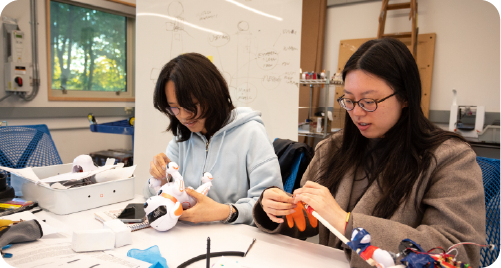 The problem, he said , is that “sometimes people don’t really use the doormat.”
The toy dog’s voice gave him a way to turn that frustration into a personality. Its existing responses could demand attention or express appreciation, making the mat’s insistence audible.
“I found the robot dog sound is pretty obnoxious,” Zhu said. His own concern for cleanliness can also be “obnoxious to other people,” he said.
The project connected with his research in fabrication and human-computer interaction, giving him a way to explore how movement and sound could give an ordinary object a personality.
Finding new uses for familiar movements
Yiqi Chen, a master of professional studies (MPS) student in information science, started with a decision she sometimes faced after cooking: which seasoning should she have added?
Chen let her robotic dog decide.
With only a week to build a prototype, she focused on the movements the toy already offered.
Chen studied the dog’s back-leg movement and connected it to the shaking motion needed to dispense seasoning. Lightweight paper containers could attach to its tail, while touching its nose would activate the movement.
“People cook for their pets, and pets don’t get to choose which kind of flavors they want,” Chen said.
Her design turned that relationship around, giving the dog a turn choosing a flavor for its owner.
Testing showed that the movement did not shake seasoning out effectively. Translating a motion into a kitchen task required attention to how the container was positioned and how it moved.
Chen’s interest in robotics began during an internship at a startup that presented commercial humanoid robots for performances at events and introductions. She continued following developments in robotics. With a background in user experience design, she saw the course as a way to bring those interests together.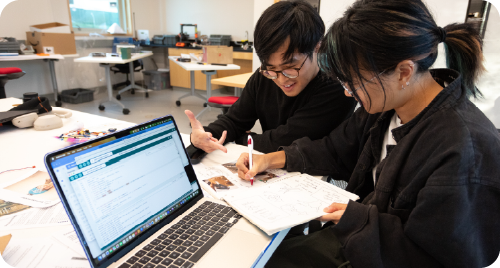 Shuang Cai, a doctoral student in the field of human-computer interaction, whose interests include artificial intelligence and speculative design, approached the dog as a collection of components that could take on new purposes. To Cai, the motor’s spinning motion suggested a wearable tool set.
Cai based the glove on the finger-gun gesture, drawing on its familiar place in childhood play and popular culture, as well as its associations with power and violence.
“What interests me is that it’s already an imaginary tool: we use our hands to imitate an object and assign meaning to an otherwise ordinary gesture,” Cai said.
The glove gave that imaginary tool physical functions through interchangeable rotating attachments, designed for activities such as washing dishes, cleaning the face, or eating a lollipop. The same remote control that originally operated the toy dog activated the glove’s mechanism.
“There’s an amusing tension in transforming a gesture associated with shooting into something used for mundane acts of care, consumption, and domestic labor,” Cai explained.
Jung’s interest in robots in social settings drew Cai to the course, particularly the opportunity to discuss collaborative relationships between people and machines.
For this project, Cai described spending much of the time exploring different possibilities before choosing a direction. Sketching a range of ideas helped connect the toy’s components to uses beyond their original purpose.
That exploration was part of the assignment. Students had to generate at least 20 initial concepts and build three rough prototypes before completing their final designs. Half their grade depended on a design logbook documenting their process.
“Spectacular failures are expected,” the project brief states.
Douae Maarouf '27 is a student writer for the Cornell Ann S. Bowers College of Computing and Information Science.