
The message arrived to Kathy Wang on a notecard. She was at a sorority event as an undergraduate student, and beforehand, her fellow sisters had been encouraged to write positive messages to one another. Senders could identify themselves or not. Kathy’s card arrived anonymously.
“Thank you for always finding a reason to smile.”
Those nine words made her day and, more than that, underscored the profound power a simple compliment can have.
“Two years later, I actually still have that card on my bedroom wall as a reminder of the amazing people I have in my life,” she said.
It was from this experience that Kathy and friend Anita Xu – both graduate students in Cornell’s Master of Professional Studies (MPS) program in information science – would conceptualize an idea to inject more positivity into the oftentimes caustic arena of social media. Fueled by a conversation over project work one night in Rhodes Hall, Kathy and Anita thought up Uplift, a friend-sourced gratitude platform where women could empower one another on social media.
“Originally intended for connection, social media has instead left many girls feeling lonelier,” Xu said, citing studies that suggest the link between social media use and depression is stronger for women than men. “Higher levels of gratitude have been found to lower anxiety and depression, and that’s where Uplift comes in.”
A kind of modernized take on Kathy’s experience with the anonymous notecard, Uplift is an app that allows women to send each other messages of gratitude – anonymously or otherwise – as well as complement each other via polls, such as “Which one of your friends is the best listener?”
Uplift is now a full-fledged startup, with Anita handling business development and Kathy handling the design strategy. They intend to launch Uplift in app stores by the end of the month.
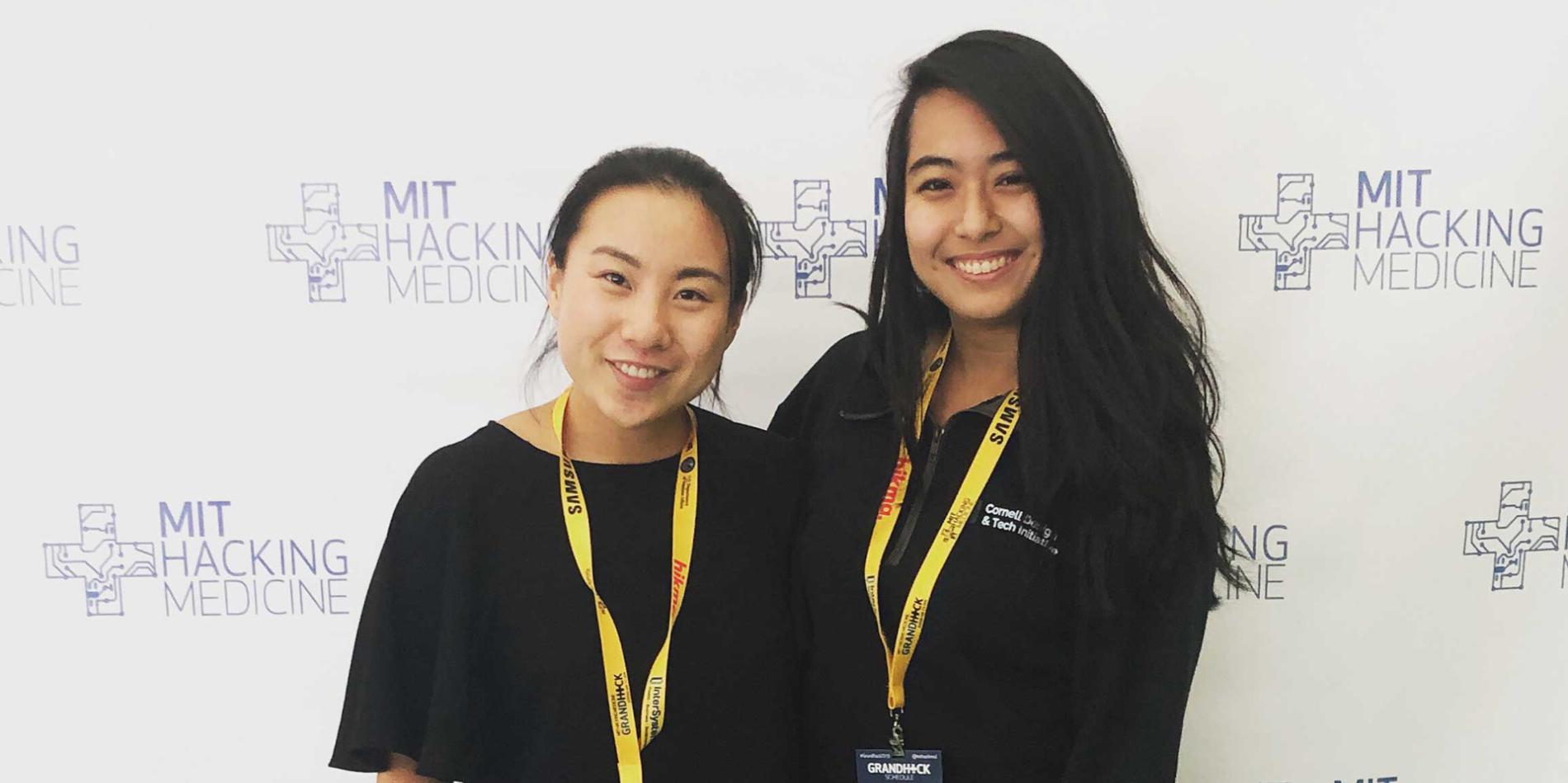
To refine their product, the pair attended MIT’s Grand Hack, a healthcare hackathon held in early May. They presented Uplift before mentors and judges and met with talented innovators who provided key insight into specifics like mobile interfaces, ways to improve app-use retention and how to measure app success.
“The MIT Grand Hack allowed us to receive a lot of good feedback from mentors with diverse backgrounds, ranging from mental health to product strategy,” Kathy said. “We were able to leverage this to refine our solution. As individuals, we were able to sharpen our storytelling and presentation skills, both of which are incredibly important in entrepreneurship.”
Both women will graduate from Cornell this May and intend to lead Uplift’s growth, even while holding down newly secured jobs. Kathy will join IBM in Austin, Texas, as a user experience designer, while Anita joins Deloitte Consulting’s New York City office as a business analyst in the company’s technology group.
How has the MPS Program furthered your career goals?
Kathy: Since I did undergrad here at Cornell, choosing to pursue a Masters degree here was a very intentional decision, as it would mean that I’d be staying in Ithaca for another year. I decided to pursue the MPS program because I wanted to strengthen my design skills, as well as dive into the entrepreneurship world.
I thought one of the best ways to strengthen my design and entrepreneurship skills was through hackathons. Thus, I competed in the Fintech, Hospitality, and Digital Transformation hackathons in my first semester as an MPS student.
I was also on Cornell Design and Tech Initiative, a project team that creates apps to help the Cornell community. I was a designer on Flux, an app that gauges the crowdedness of dining halls, study spots, and gym facilities on campus. Throughout this past year, I helped build out the app from conception to launch. Throughout this entire process, I was able to use both my design and entrepreneurship skills.
Moreover, through the Digital Technology Immersion (DTI) track of the MPS program, I took NBA 5640, Entrepreneurship and Business Ownership. It was here that I met the rest of the ArcAffinity team. We applied to eLab (a competitive incubator program) together, and got in. It was through eLab where I was first exposed to customer discovery, venture capital, and the entire startup process.
After eLab came to a close, I began Uplift with Anita. We actually came together one day in the Rhodes lab, when we were both doing homework. I told her I wanted to enter this competition, and she said she was down to do it with me. And thus began Uplift. We proceeded to enter into more than ten competitions (including the Engineering Innovation Competition, MIT Grand Hack, NYS Business Plan Competition, TAMIDTank, etc.). In the course of one semester, we built out a business plan and a design prototype.
The MPS program has allowed me to really engage with the Cornell community, and I’ve learned that design and entrepreneurship go hand-in-hand in so many ways. Not only has the MPS program given me a chance to work at IBM, it’s also allowed me to start my own journey of entrepreneurship. I’m very excited to see what the future holds.
Anita: The interdisciplinary nature of the MPS program has enabled me to develop my technical, design and business skillset. It has also challenged me to think more critically about the moral, ethical and social implications facing the development of next generation technologies and how to develop solutions that are conscious of potential harmful effects.
The curriculum’s design and course selection were instrumental to my professional development and personal growth. Courses such as “Business Intelligence Systems”, “Learning Analytics” and “Introduction to Python” helped me to improve my data analysis and programming abilities. I was able to hone my understanding of finance and entrepreneurship through “Entrepreneurial Finance”, “Valuation Principles” and “Leading Agile Innovation”. Many of the courses taken to complete the program require team-based projects and I found these to be extremely enriching experiences.
More importantly, the MPS and Cornell community were extremely caring and invested in my success. From peers being highly supportive during recruiting and exam season, to the hands-on career and program advice from Cynthia Todd, Barbara Woske and Gilly Leshed, I felt empowered to push myself out of my comfort zone. I am very thankful to the MPS faculty, staff and my peers for supporting me on my journey. I hope to use the learnings and experiences gained through the MPS program for good in my next chapter and beyond.
Louis DiPietro is a writer for the Cornell Ann S. Bowers College of Computing and Information Science