BURE summer scholars embark on open world of research
By Louis DiPietro
On
Share
During his first year at Cornell and with summer in sight, Andrew Arena ’28 learned what many aspiring researchers like him eventually discover: opportunities to get undergraduate research experience are scarce.
He thought of wading into the competitive frenzy for a summer internship or cold-emailing dozens of labs across the country for a place on a research team. But even if he did land something, Arena wondered if he could meaningfully contribute as a novice researcher.
“That’s hard to do if you don't feel like you have any background yet, right?” said Arena, a computer science major.
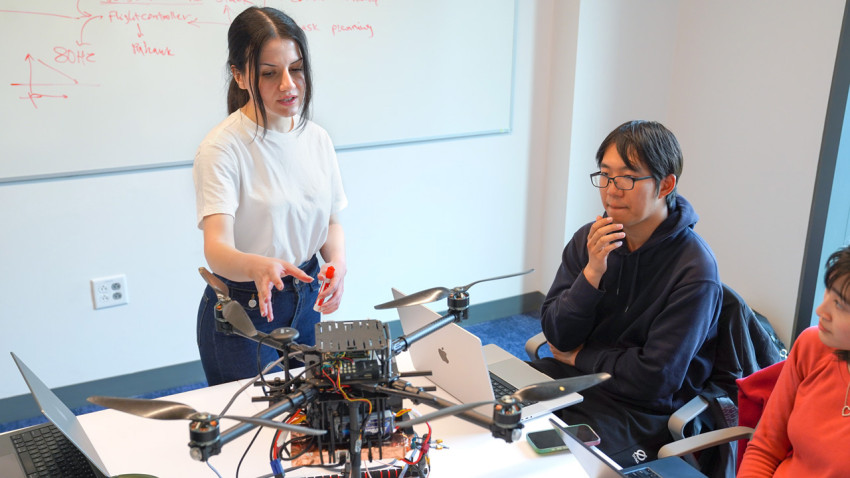
“With BURE, even without much research knowledge, I can still fit in,” said Arena, while sitting in his office space in Gates Hall strewn with computer hardware. “That’s what got me to apply.”
Paving career pathways for students
I realize it is possible to combine biology and statistics, which was always my goal. I just never really knew how to combine the two. This program showed me how to do that.
Anna Savchuk ’27 Statistics and Data Science
Now in its third year, the annual, 10-week, paid summer program within the Cornell Ann S. Bowers College of Computing and Information Science offers undergraduates a crash course in research life. Each summer, around 60 Cornell Bowers undergraduates partner with dozens of participating faculty and their graduate students to work full-time on research projects in fields ranging from robotics and natural language processing to biostatistics and bias in artificial intelligence systems. The point? To offer students mentorship and meaningful, first-hand experience in what it takes to be a researcher so they can decide if research and graduate school are right for them – and perhaps be an author on a published academic paper, too.
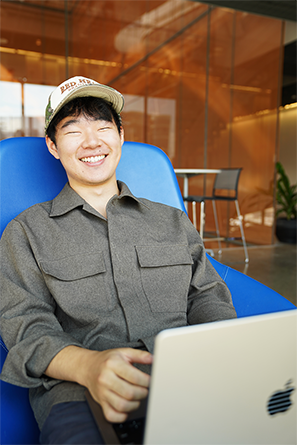
“I have really enjoyed getting to show up, work, and think of new ideas,” said Arena, who worked on an augmented reality interface to computationally simplify the creation of light paintings, a photographic technique using a light source and a long exposure in a darkened room. Building off research from Peter Michael, a doctoral student in the field of computer science, Arena’s project is advised by Abe Davis, assistant professor of computer science in Cornell Bowers. “It's just super exciting to come up with new ideas and tackle problems that lack clear pathways to solutions. Even the ambiguity about what the final result will look like is exciting to me.”
Laerdon Kim ’28 is another Bowers student who dedicated his summer to research. Kim, a computer science major, was confident he wanted to explore research before he arrived at Cornell, but he was certain of it on his first day in Gates Hall last fall.
“I attended a lab meeting, and all of these students –
Laerdon Kim ’28
Ph.D.s, master’s, and undergrads who were older than me – were firing off new ideas, talking about this task and this research problem,” Kim said. “I had this little-kid excitement in finding something totally new and outside of classwork.”
This summer, Kim worked with Cristian Danescu-Niculescu-Mizil, associate professor of information science at Cornell Bowers, and some of his graduate students on a conversational forecasting model, a computational tool that can predict when online conversations are about to turn contentious.
“BURE is one of the primary avenues where you can do research as an undergraduate, and I wish there were more,” Kim said. “I really think that research is one of the highest impact things that you can do as an undergraduate, and I don’t have the slightest clue why 100% of campus isn’t doing it.”
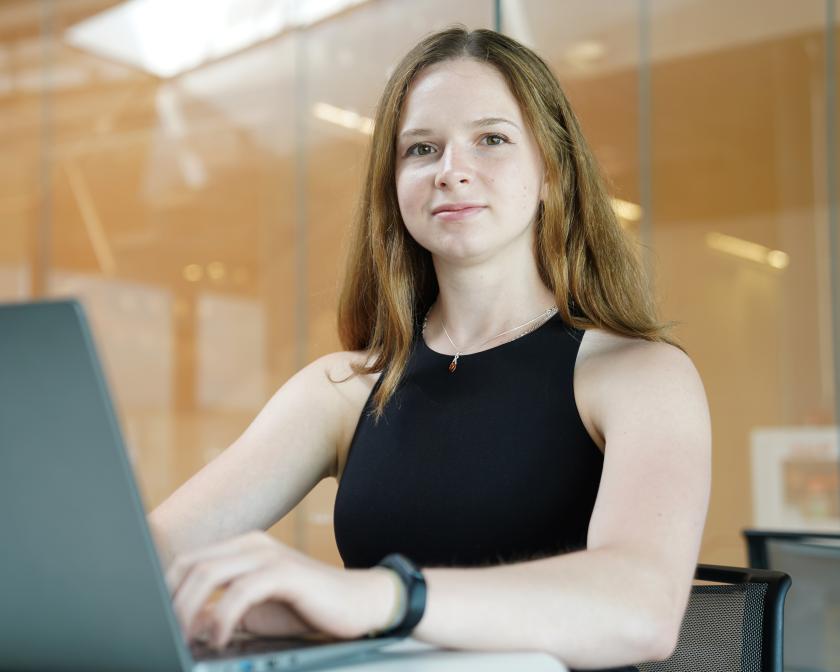
Beyond chipping away at research projects, BURE students like Savchuk complete the program with some clarity about their career aspirations. She initially figured she’d pursue a Ph.D. in a field like biology, but her experience in BURE now has her considering biostatistics.
“I realize it is possible to combine biology and statistics, which was always my goal,” she said. “I just never really knew how to combine the two. This program showed me how to do that.”
For many BURE students, the shift from semester course work – with firm deadlines, definable goals, and clear metrics – to the open world of research and all its ambiguities can be jarring and a bit overwhelming at first. Arin Khare ‘28, a computer science major, found it rewarding, even fun.
“I felt I had to learn things very quickly, but I also learned a lot. It’s nice to have a bit of freedom,” said Khare, who worked with David Shmoys, professor of computer science and the Laibe/Acheson Professor of Business Management and Leadership Studies in Cornell Engineering’s School of Operations Research and Information Engineering, on an algorithm-assisted approach to organizing kidney exchanges. “BURE has shown me that, in research, there are so many questions you must weigh that don’t have clear answers. My initial thought was, ‘If I were a real researcher at an institution, I would just know the answers.’ That’s not true at all.”
“One of BURE's most important features is that it gives undergraduate students a genuine research experience,” said Dan Kowal, associate professor of statistics and data science and BURE faculty co-lead. “Their research is fully immersive – they listen to seminars and interact with their lab groups, and they present original work to their peers. That's how Ph.D. students and faculty experience research, and BURE brings that to Bowers undergraduates.”